

Introduction: The Costly Mistake That Nearly Ended My Affiliate Journey
Picture this: you’ve spent weeks setting up your website, writing content, building your email list. You’re finally ready to promote your first affiliate product. You click “publish” on your carefully crafted promotional post, share it everywhere, and then… nothing. No clicks. No sales. Just crickets.
Worse still, the few people who did click through never bought anything. And now you’re sitting there wondering if affiliate marketing even works, or if you’ve just wasted months of your life chasing another internet pipe dream.
I know this feeling intimately because I lived it. Not once, but multiple times.
The Paralysis of Too Many Choices
When you first dive into affiliate marketing, you’re immediately bombarded with options. Thousands of products across dozens of platforms, all promising to be “the perfect affiliate offer.” ClickBank has 10,000+ products. Amazon has millions. ShareASale, CJ Affiliate, Impact, the list goes on.
Everyone’s shouting about high commission rates, recurring revenue, and massive conversion rates. But nobody’s telling you which one is actually right for you and your audience. So you freeze. Or worse, you pick based on completely the wrong criteria.
Why Most Beginners Pick Products That Never Convert
Here’s what usually happens: you search for “highest paying affiliate programs” and find something offering 50% commissions on a $2,000 course. Your eyes light up. $1,000 per sale? You only need a few of those per month and you’re sorted!
So you sign up. You create content. You promote it passionately.
And absolutely nothing happens.
Why? Because you’ve just tried to sell a $2,000 advanced business course to an audience of complete beginners who are still figuring out if this whole online business thing is even legitimate. They don’t trust you yet. They don’t trust the product. And they certainly don’t have two grand lying around to spend on something they’re not even sure they need.
I made this exact mistake. Multiple times. With Amazon FBA courses. With Forex trading systems. With high-ticket coaching programmes that promised the world but meant absolutely nothing to my audience.
What This Article Will Do for You
This article isn’t going to give you a list of “the top 10 affiliate products to promote.” You can find those lists anywhere, and they’re usually rubbish because they don’t know you, your audience, or what you’re actually trying to build.
Instead, I’m going to walk you through the exact framework I use now before promoting anything. It’s the same framework that saved me from countless expensive mistakes whilst helping me build genuine trust with my audience.
By the end of this article, you’ll have a clear, step-by-step process for evaluating any affiliate product. You’ll understand the three pillars that make or break your success. And you’ll know exactly how to spot the red flags that signal a product will waste your time and damage your credibility.
Understanding Why Product Selection Makes or Breaks Your Success
The Domino Effect of Wrong Product Choices
Choosing the wrong affiliate product isn’t just a minor setback. The consequences ripple through every single aspect of your affiliate marketing business.
When you promote the wrong product, you create content that doesn’t resonate. Your audience can sense the disconnect, even if they can’t quite put their finger on it. Your emails feel forced. Your blog posts lack genuine enthusiasm. Your social media content comes across as salesy rather than helpful.
Then the metrics start reflecting this. Low click-through rates. Even lower conversion rates. Your audience stops engaging. Some unsubscribe. Others just go quiet.
But here’s the really damaging part: you start doubting yourself. You question whether you’re any good at this. You wonder if affiliate marketing is just another overhyped scam. You consider giving up and going back to whatever you were trying to escape from in the first place.
My Expensive Lessons from Promoting the Wrong Things
Let me be brutally honest with you about my journey. I spent three years testing different online business models before I figured out what actually works. And “testing” is a polite way of saying “making expensive mistakes.”
I tried promoting Amazon FBA courses when I’d never even sold anything on Amazon myself. I couldn’t answer basic questions from my audience. I couldn’t troubleshoot their problems. I was essentially a parrot repeating marketing copy I didn’t understand.
Result? Zero sales. Damaged credibility.
Then I pivoted to Forex trading courses because the commissions looked attractive. Never mind that I had no personal experience with Forex and my audience of people wanting to escape their 9-to-5 jobs weren’t looking to spend their days staring at currency charts.
Result? More zero sales. More time wasted.
Each wrong choice cost me months of effort, hundreds of hours of content creation, and countless opportunities to actually help people whilst building a sustainable income.
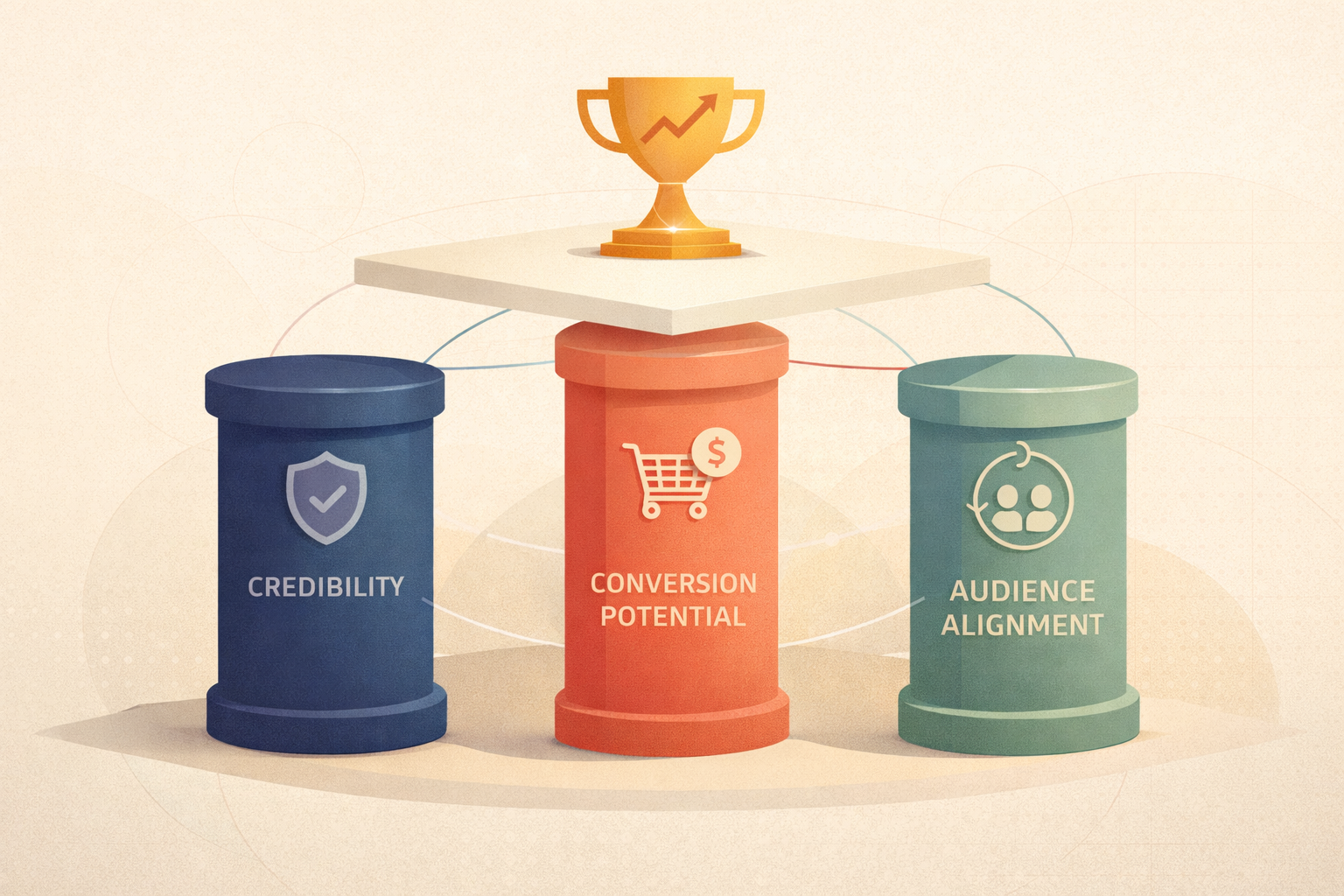
The Three Pillars of Successful Product Selection
After all those failures, I finally figured out what I’d been missing. Every successful affiliate product choice sits on three foundational pillars. Miss any one of them, and the whole thing collapses.
First Pillar: Credibility. Can you authentically and knowledgeably promote this product? Do you believe in it? Would you buy it yourself? Can you answer questions about it?
Second Pillar: Conversion Potential. Will this product actually sell to your audience? Is the price point appropriate? Are the sales materials effective? Does the vendor provide good support?
Third Pillar: Audience Alignment. Does this product solve a real problem your audience has right now? Is it appropriate for their skill level and situation?
Get all three right, and you’ve got a winner. Miss even one, and you’re setting yourself up for disappointment.
Pillar One: Can You Credibly Promote This Product?
The Authenticity Test Nobody Talks About
Here’s an uncomfortable truth that most affiliate marketing advice completely ignores: if you don’t genuinely believe in what you’re promoting, your audience will know.
Not consciously, perhaps. They might not sit there thinking “this person’s being fake.” But they’ll feel something’s off. Your content will lack conviction. Your recommendations will sound hollow. Your enthusiasm will feel manufactured.
I learnt this the hard way with those Forex courses. Every piece of content I created felt like pulling teeth because I was trying to sound knowledgeable about something I barely understood. My audience might have been beginners, but they weren’t stupid. They could sense the disconnect.
Contrast that with when I finally started promoting something I’d actually used and believed in. Suddenly, content creation became easy. I had real stories. Genuine enthusiasm. Specific details. The difference in engagement was night and day.
Have You Used It or Would You Actually Buy It?
This is your first and most important filter. Before you even look at commission rates or conversion statistics, ask yourself: “Have I personally used this product? And if not, would I genuinely buy it with my own money?”
If the answer to both questions is no, stop right there. It doesn’t matter how attractive the commission structure looks or how desperate you are to start earning. Promoting products you haven’t used and wouldn’t buy is a recipe for disaster.
Now, I’m not saying you must use every single product before promoting it. That’s unrealistic, especially with higher-priced items. But there’s a difference between “I haven’t purchased this yet but I absolutely would if I had the funds” and “I’d never buy this myself but maybe someone else will.”
When I promote Internet Profits Academy, I do so because I genuinely believe in the training and the approach. I’ve experienced the value. I know what’s inside. I can speak to specific modules and how they helped me. That authenticity comes through in every piece of content I create about it.
Does It Match Your Current Knowledge Level?
There’s a sweet spot in product selection that beginners often miss. You don’t want to promote products that are far beyond your own knowledge level, because you’ll struggle to create genuinely helpful content.
Think about it this way: if you’re just learning affiliate marketing yourself, you shouldn’t be promoting advanced SEO software that requires technical expertise you don’t have. You can’t troubleshoot problems. You can’t provide insights beyond the sales page copy. You’re out of your depth.
The ideal product sits just slightly ahead of where you are now, or addresses a problem you’ve recently solved yourself. You understand it well enough to explain it. You’re close enough to the beginner experience that you remember what confused you.
This is why I can credibly promote affiliate marketing training. I’m not pretending to be a guru with decades of experience. I’m a few steps ahead of my audience on the same journey, sharing what’s working and what isn’t. That’s relatable. That’s helpful. That’s credible.
The Anti-Guru Reality Check
This one’s personal for me because it goes to the core of how I operate. I refuse to promote products that make unsubstantiated income claims, promise overnight success, or use aggressive guru-style marketing tactics.
Why? Because I’ve been on the receiving end of that nonsense. I know how it feels to be desperate for a solution, see some guru flashing rented Lamborghinis and promising you’ll be making $10,000 per month by next Tuesday.
I won’t do that to my audience. Period.
So when I’m evaluating a product, I look carefully at how it’s marketed. Does the sales page promise realistic results? Does it acknowledge the work required? Does it avoid income claims or, if it includes them, are they properly qualified?
If I see red flags like “push-button profits,” “no experience needed,” “get rich quick,” or any variation of that rubbish, I immediately disqualify the product. I’m not attaching my name to it.
This might mean you promote fewer products. It might mean you pass on some lucrative opportunities. But it also means you build genuine trust with your audience. That trust is worth infinitely more than any single sale.
Pillar Two: Will This Product Actually Convert for Beginners?
Understanding Your Audience’s Real Problems
Here’s where most beginners get product selection completely backwards. They choose products based on what they find interesting or what offers high commissions, without ever stopping to consider what their audience actually needs.
Your audience isn’t you. They’ve got real problems keeping them up at night.
If you’re targeting people wanting to escape the 9-to-5 grind like I do, their problems look like this: they’re exhausted from corporate politics and meaningless work. They’re living paycheck to paycheck despite working full time. They’re terrified of being scammed by yet another “make money online” scheme. They’re overwhelmed by conflicting advice.
Those are the problems your affiliate product needs to solve. Not the problems you find intellectually interesting. The actual, keeping-them-awake-at-3am problems your specific audience is dealing with right now.
The Price Point Sweet Spot for First-Time Buyers
Let’s talk about money. Specifically, how much your audience is willing to spend with someone they don’t fully trust yet.
There’s a conversion sweet spot for beginners building their first affiliate income, and it’s not where you might think. Most beginners see high-ticket products (anything over $500) and think “brilliant, I only need a few sales per month.” But here’s the reality: selling expensive products to cold traffic is incredibly difficult.
Your audience doesn’t know you yet. They might like your content, but that doesn’t mean they trust you with hundreds or thousands of dollars. They’re testing the waters. They want to see if this online business thing is legit before they invest serious money.
For beginners, products priced between $30 and $200 tend to convert far better than anything more expensive. This is the “reasonable risk” range. People can justify spending this amount to test something without feeling like they’re gambling their mortgage payment.
Does this mean you should never promote high-ticket products? No. But you shouldn’t start there. Build trust first with appropriately priced products that deliver genuine value.
I’ve seen far too many beginners chase high-ticket commissions and end up with nothing to show for it except wasted effort. Meanwhile, promoting a $97 product that converts well can generate consistent income whilst building the trust needed for bigger offers later.
Evaluating Sales Pages and Marketing Materials
Here’s something most affiliate marketing courses skip over: the vendor’s sales materials are just as important as the product itself. You can have a brilliant product that nobody buys because the sales process is confusing or off-putting.
Before promoting any product, I thoroughly review the entire customer journey. I click through to the sales page. I read every word. I watch any sales videos. I look at the checkout process.
Specifically, I’m looking for these things:
Clarity: Is it immediately obvious what the product is and who it’s for?
Professionalism: Does the page look legitimate? Are there spelling mistakes or broken images?
Honesty: Does the copy make realistic claims? Or is it full of red flags like fake scarcity and inflated income promises?
Simplicity: Is the checkout process straightforward? Or are there confusing upsells and complicated payment options?
Remember: when you promote a product, you’re essentially vouching for the entire experience, not just the product itself. If the sales process damages trust, that reflects on you.
Commission Structure Reality: Higher Isn’t Always Better
This one trips up almost every beginner, including me when I started. You see a product offering 50% commissions and another offering 20%, and you think “obviously I should promote the one with higher commissions.”
But that’s backwards thinking.
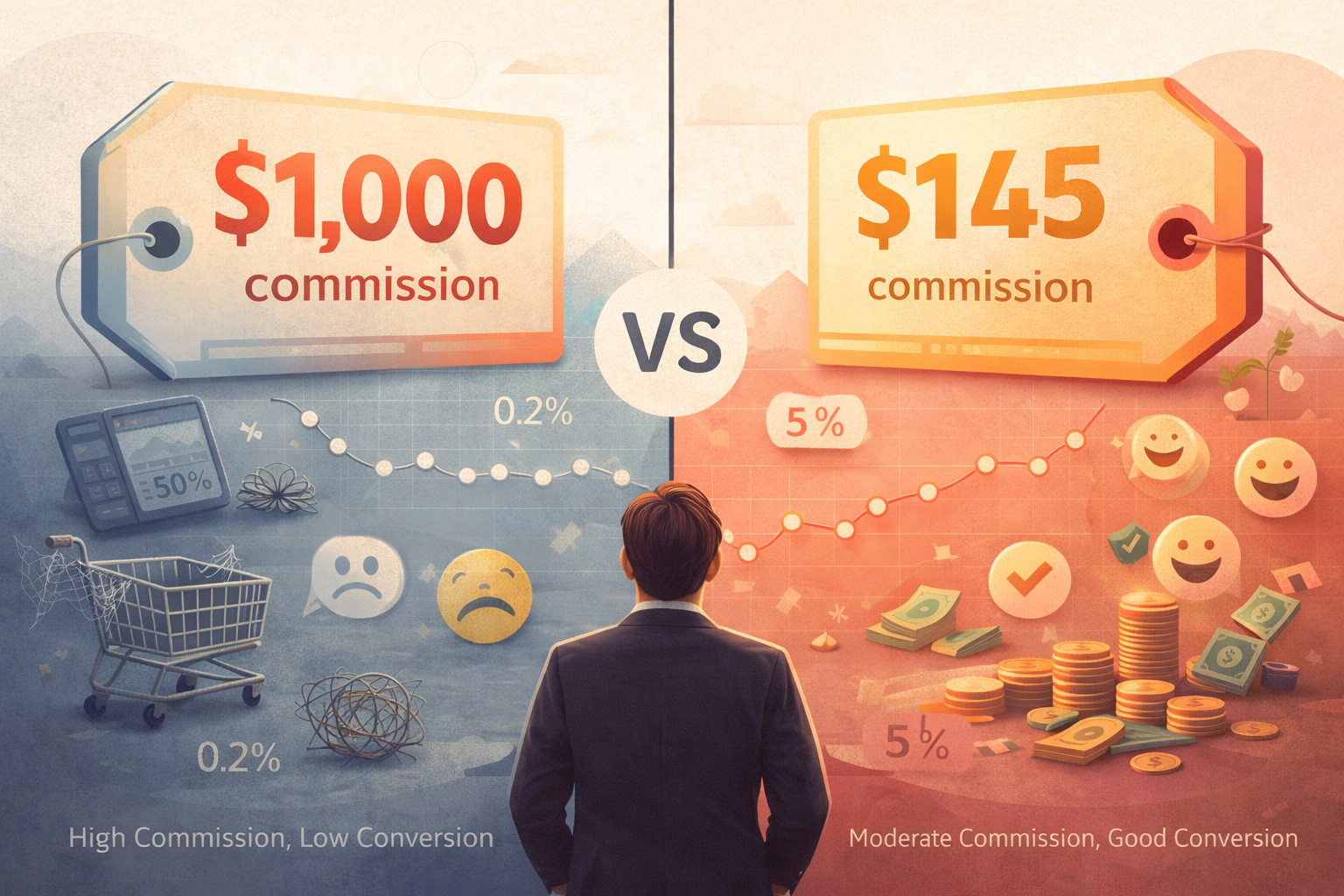
A product offering 50% commission that never converts earns you exactly nothing. A product offering 20% commission that converts consistently will earn you far more in the long run.
I’d rather promote a $97 product at 30% commission that converts at 5% than a $997 product at 50% commission that converts at 0.2%. The maths is simple: the first scenario earns roughly $14.55 per 100 clicks. The second scenario earns roughly $9.97 per 100 clicks.
But more importantly, the first scenario builds momentum. You’re getting regular sales. You’re seeing proof that this works. You’re building confidence.
When I evaluate commission structure, I look at the total picture: commission percentage, product price, estimated conversion rate, and payment terms. A lower commission on a product that converts well and pays reliably beats a high commission on something that’s nearly impossible to sell.
Focus on real earnings potential, not theoretical commission percentages.
Pillar Three: Does It Align with Your Audience’s Journey?
Where Your Readers Are Right Now
Your audience isn’t where you are. They’re not where the advanced marketers are. They’re where they are right now, in this specific moment, with their specific problems and circumstances.
If you’re targeting beginners who are frustrated with traditional employment and looking for alternatives, here’s where they actually are:
They’re scared. They’ve probably been burned before by schemes that promised easy money. They’re sceptical of anything that sounds too good to be true. They’ve got limited funds to invest. They’re working full time, so they’ve got limited hours. They’re overwhelmed by how much there is to learn.
This is their reality. Not the reality you wish they had. Their actual, messy, complicated reality.
Any product you promote must meet them where they are. This means the product needs to be appropriate for complete beginners. It needs to acknowledge their fears and address them directly. It needs to fit within their time and money constraints.
The Beginner-Friendly Requirement
This should be non-negotiable if you’re targeting beginners: the product must be genuinely beginner-friendly. Not “beginner-friendly” in marketing speak that actually means “you only need five years of experience instead of ten.” Actually beginner-friendly.
What does that look like in practice?
The product assumes zero prior knowledge. It explains concepts in plain English without jargon. It provides step-by-step guidance, not just theory. It includes examples and templates, not just principles. It offers support when people get stuck.
I can’t count how many products I’ve seen marketed as “perfect for beginners” that immediately dive into technical concepts, assume familiarity with industry tools, and provide vague guidance that only makes sense if you already know what you’re doing.
When evaluating a product, I actually look at the first lesson or module if possible. What does it assume you already know? What’s the pace of progression? How much hand-holding does it provide?
Your beginners need products that meet them at absolute ground level and guide them forward with clarity and support.
Long-Term Relationship Building vs Quick Wins
Here’s the final piece of audience alignment that separates sustainable affiliate marketing from short-term cash grabs: how does this product affect your long-term relationship with your audience?
Every product you promote either builds trust or spends it. If you promote something that genuinely helps your audience, they come back for more recommendations. If you promote rubbish just because the commission looked good, you’ve damaged the relationship, possibly permanently.
Think beyond the immediate sale. Ask yourself: “If my audience buys this product based on my recommendation, will they thank me in six months? Or will they feel like I’ve led them astray?”
This is why I’m so careful about what I promote. I’m not building a business that depends on churning through new audience members. I’m building a business based on long-term relationships with people who know I consistently point them towards genuinely helpful resources.
Red Flags That Scream “Don’t Promote This”
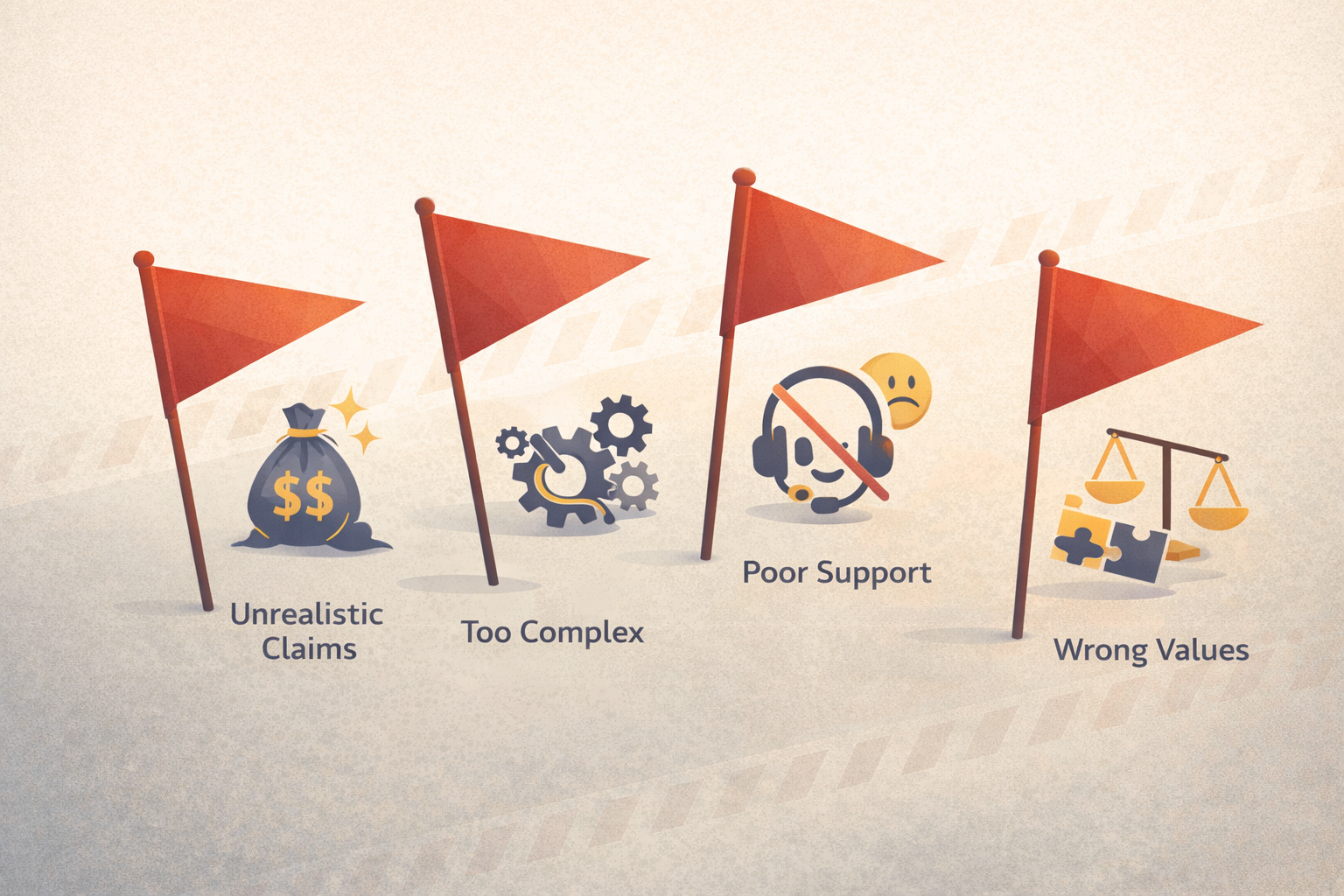
Warning Sign One: Unrealistic Income Claims
This is my number one non-negotiable red flag. If a product’s marketing includes unsubstantiated income claims, promises of overnight success, or implies you’ll be making thousands within weeks, I don’t care how good the product itself might be, I’m not touching it.
Why? Because these claims damage your credibility by association. When you promote a product that promises “$10,000 per month by next Tuesday with no experience,” your audience will rightly question your judgement.
Look for these specific red flags:
Screenshots of bank accounts or payment processor dashboards without context. Anyone can fake these.
Claims like “average earnings” without proper disclosure about what percentage of users actually achieve those results.
Before and after income comparisons that show dramatic results in unrealistically short timeframes.
Any variation of “results not typical” buried in tiny text whilst the main sales message screams about how much money you’ll make.
I’ve passed on promoting products that were actually quite good because the marketing was full of this rubbish. Your reputation is built on trust, and these income claims erode trust faster than anything else.
Warning Sign Two: Overly Complicated Systems
Some products seem impressive because they’re complicated. They’ve got seventeen different modules, use advanced software, require integration with multiple tools, and assume you’ve got technical expertise you probably don’t have.
Beginners see this complexity and think “wow, this must be comprehensive.” But complexity isn’t the same as quality.
Red flags for overly complicated systems include:
Products that require expensive additional tools or subscriptions before you can even start.
Training that assumes technical knowledge you don’t have.
Systems with too many moving parts. The more steps required, the more likely your audience will give up in frustration.
Products that require significant time investment before seeing any results.
Remember: your audience is already overwhelmed. The last thing they need is a product that adds more confusion to their lives. Look for products that simplify the process, not complicate it.
Warning Sign Three: Poor Vendor Support
You can have a brilliant product, but if the vendor doesn’t support their customers or affiliates properly, you’re going to have problems. And those problems reflect on you because you recommended the product.
Here are the red flags I look for:
No clear contact method. If you can’t easily find a way to contact the vendor, how will your audience get help?
Slow or non-existent responses. Test this by reaching out with a question before you commit to promoting.
Negative reviews mentioning support issues. Search for reviews and pay attention to comments about customer service.
No affiliate support materials. Good vendors provide promotional resources for affiliates.
Payment issues reported by other affiliates. Search for the product name plus “affiliate complaints” or “payment problems.”
Do your due diligence on the vendor, not just the product.
Warning Sign Four: Misalignment with Your Values
Even if a product passes all the other tests, if something about it contradicts your core values, don’t promote it.
For me, this means refusing to promote products that:
Use aggressive or manipulative marketing tactics.
Promise results without effort.
Target vulnerable people with misleading claims.
Include upsells that feel exploitative.
Contradict the practical, no-nonsense approach I’m building my brand around.
You might have different values than mine. The point is to be clear about what yours are and stick to them. Don’t compromise your principles for a commission.
Starting with One Product (and Why That’s Perfectly Fine)
The Focus Advantage for Beginners
Here’s something that might surprise you: when you’re starting out, promoting a single product is actually better than promoting multiple products.
I know this contradicts most affiliate marketing advice, which tells you to diversify and promote loads of different things. But that advice is for established affiliates. For beginners, focus beats diversification every single time.
Why? Because you’ve got limited time, limited experience, and limited trust with your audience. Spreading yourself across multiple products means you’re creating mediocre content about several things instead of exceptional content about one thing.
When you focus on a single product, you become genuinely knowledgeable about it. You learn its features inside out. You understand common objections and how to address them. You discover what resonates with your audience and what doesn’t.
Plus, when your audience sees you consistently recommend the same thing across multiple pieces of content, it reinforces that you genuinely believe in it. You’re not just throwing random affiliate links at them hoping something sticks.
I focus exclusively on Internet Profits Academy for affiliate marketing. Not because I couldn’t find other products to promote, but because I wanted to build genuine expertise. That focus paid off far more than scattered promotion ever could have.
Creating Better Content Around Fewer Products
When you’re only promoting one or two products, you can create much deeper, more valuable content. You’re not just writing surface-level reviews that regurgitate sales page copy.
With a single product focus, you can create:
Detailed comparison content. How does this product compare to alternatives? What makes it different?
Specific use cases. Show exactly how to use it to solve particular problems your audience has.
Troubleshooting guides. Address common sticking points and questions.
Progress updates. Share your own experience using the product over time.
This depth of content simply isn’t possible when you’re spreading yourself across multiple products. You end up creating shallow, promotional content that doesn’t really help anyone.
I’d rather see you create 15 genuinely valuable pieces of content about one product than 30 mediocre pieces about ten products.
When to Add Your Second and Third Products
So when should you expand beyond your initial product? Here are the signals I look for:
You’re consistently making sales. If your first product isn’t converting yet, adding more products won’t fix the problem.
You’ve created comprehensive content about your first product. You should have at least 8-10 solid pieces of content before considering another product.
Your audience is asking about alternatives or adjacent solutions. Pay attention to questions and comments.
You’ve identified a clear gap in your product offering. Maybe your first product is excellent for complete beginners but there’s nothing for people ready for the next step.
For most beginners, this means sticking with one product for at least three to six months. I know that feels like ages when you’re excited to grow, but building a strong foundation with one product will serve you far better than rushing to promote multiple things.
Building Your Affiliate Portfolio Over Time
Once you’re ready to expand, do so strategically. Your product portfolio should be complementary, not competitive. Each product should serve a different need or different stage of your audience’s journey.
For example, my progression looks like this:
Primary product: Internet Profits Academy for beginners learning affiliate marketing fundamentals.
Secondary products: Specific tools that complement the training, introduced after people have grasped the basics.
Advanced products: Higher-level resources for people who’ve implemented the fundamentals and are ready for more sophisticated strategies.
Notice how each level builds on the previous one? That’s intentional. I’m creating a clear path forward for my audience rather than randomly promoting disconnected products.
But add products slowly and thoughtfully. A carefully curated portfolio of 3-5 excellent products that you genuinely believe in will always outperform a scattered collection of 20 products you’re promoting simply because they offer affiliate programmes.
Your Action Plan for This Week
Right, enough theory. Let’s get practical.
Action One: List Five Potential Products
Your first task this week is to create a shortlist of potential products to evaluate.
Start by writing down the top three problems your audience is trying to solve. Be specific. Not “make money online” but “escape their 9-to-5 job without taking massive financial risks.”
Then, for each problem, identify 1-2 products that could potentially solve it.
Where to find these products:
Search major affiliate networks like ClickBank, ShareASale, or CJ Affiliate.
Google “[your niche] + affiliate programme” to find direct programmes.
Think about products or services you’ve personally used or researched.
Ask in relevant Facebook groups or forums what products people find helpful.
Aim for a list of five potential products. Write down the product name, what problem it solves, price point, and commission rate.
Action Two: Apply the Three-Pillar Framework
Now take your list of five products and run each one through the complete evaluation framework.
Create a simple spreadsheet with these sections for each product:
Personal Alignment:
- Would I buy this with my own money?
- Do I genuinely believe it will help my audience?
- Can I create authentic content about it?
- Does it align with my values?
- Am I excited to promote it?
Conversion Potential:
- Is the price point appropriate?
- Is the sales page professional and clear?
- What’s the realistic conversion rate?
- Does the vendor provide good support?
- Are the terms reasonable?
Audience Alignment:
- Does it solve a specific problem my audience has now?
- Is it appropriate for complete beginners?
- Does it match their values?
- Will it build long-term trust?
Be honest in your assessments. You’re looking for a product that scores well across all three pillars.
Action Three: Make Your Decision and Commit
By now, one product should be standing out as the clear winner.
Make the decision. Actually write it down: “I am going to promote [product name] as my first affiliate product.”
Then do these things:
Sign up for the affiliate programme and get your links set up.
Purchase the product if you haven’t already. You absolutely must know what you’re promoting inside out.
Create a folder for product information. Save your affiliate links, key features, and any promotional materials.
Set a review date three months from now to assess how it’s performing.
The key here is commitment. Give your chosen product a proper chance with focused effort for at least three months.
Action Four: Plan Your First Three Content Pieces
Finally, plan out your first three pieces of content about this product.
I recommend starting with:
Content Piece One: Problem-Focused Blog Post. Write about the specific problem your product solves without immediately jumping to the product recommendation.
Content Piece Two: Detailed Review. Create in-depth content showing what’s inside the product, who it’s for, and what results people can expect.
Content Piece Three: Success Story. Share your own experience using the product or interview someone who’s used it successfully.
Plan these out with specific headlines and key points. Schedule when you’ll create each one.
Conclusion: The Right Product Changes Everything
Choosing your first affiliate product might feel like a small decision, but it’s actually the foundation of everything you’re building. Get it right, and you set yourself up for consistent progress, growing trust with your audience, and the confidence that comes from seeing this actually work.
Get it wrong, and you’ll spend months creating content that doesn’t convert, questioning whether you’re cut out for this.
The difference between those two outcomes isn’t luck. It’s following a systematic framework for evaluating products against clear criteria.
You now have that framework. You understand the three pillars: personal alignment, conversion potential, and audience alignment. You know the red flags to avoid. You know why starting with one focused product beats scattered promotion of many.
So here’s what I want you to do: take action this week. Don’t sit on this information for months whilst you keep researching. Run through the framework. Make a decision. Commit to it. Start creating content.
You’ll learn more from three months of focused action than from three years of endless research.
Ready to Stop Making These Mistakes?
If this post helped you, share it with someone who needs to hear it.
Ready to skip the trial and error? Most beginners waste months on strategies that sound good but lead nowhere. I’ve made those mistakes and I created a free guide that calls out the 7 biggest lies keeping people from making real progress.
Get “7 Make Money Online Lies That Keep Beginners Stuck” and join my daily emails where I share what’s actually working, the lessons I’m learning, and the strategies behind my results. No theories, just real experience from someone building this business alongside you.
All the best,
Atif
Hi Atif – Great post! I really appreciate how you break product selection into credibility, conversion potential, and audience alignment because it turns a confusing decision into a practical process. The reminder to start with one product and build trust through real experience is powerful, especially for beginners who feel pressure to chase high ticket offers too soon. This framework encourages patience, integrity, and long-term thinking, which ultimately leads to more authentic results for both the marketer and the audience. Thanks for the thoroughness and thought put assisting those (and me) with this topic!
Thanks so much for taking the time to read it! Really glad the framework resonated with you, that’s exactly what I was hoping to achieve. Breaking it down into manageable steps instead of overwhelming people with too many options. You’re spot on about the pressure beginners face with high ticket offers. I’ve seen (and felt) that temptation myself, but starting with one solid product you genuinely believe in just makes the whole process less stressful and more authentic. Appreciate you mentioning the long-term thinking aspect too. It’s easy to forget that building trust actually pays off more than chasing quick commissions. Thanks again for the thoughtful comment, means a lot to know it’s helping!
A great compilation of what is needed to succeed with Affiliate Marketing. It’s relatively simple but not easy. Good luck with your endeavors.
Thanks for reading and for the encouragement! You’ve nailed it with that line, “relatively simple but not easy.” That’s exactly how it feels most days.
The fundamentals aren’t complicated, but actually sticking with them and doing the work consistently? That’s where the real challenge is. Appreciate you taking the time to comment and the good luck wishes. All the best with your own journey too!
Hi Atif,
Great blog with some fantastic information that anyone starting their online business must read.
I think the biggest thing everyone needs to do is put aside any ego they may have and thoughts of “I know what’s best for me and will work” because NO, you don’t know what works and NO you won’t be able to make this work without some kind of support mechanism and NO you don’t know what you’re doing!
Some things will work but will only work if you ask for that help and follow it. period.
thanks for the reminder!
Marc, thanks for reading and for such a honest comment! You’ve hit on something really important there, the ego thing trips up so many people (myself included at times).
I wasted time and money in the past thinking I could figure everything out myself or that I knew better than people who’d actually done it. Turns out, swallowing your pride and actually following proven systems from people who’ve got results is far quicker than reinventing the wheel. That line “you don’t know what you’re doing” sounds harsh but it’s the truth most beginners need to hear. I definitely didn’t know what I was doing when I started, and pretending otherwise just delayed my progress.
Appreciate you adding that perspective, it’s a valuable reminder for anyone reading!
Hi Atif,
This is a refreshing and honest take on affiliate marketing. Your ‘Anti-Guru Reality Check’ really stands out; it’s so important to build a business on trust rather than ‘push-button’ hype. I especially appreciated your Three Pillars framework, particularly the ‘Authenticity Test.’ It’s a great reminder that if we wouldn’t spend our own money on a product, we have no business asking our audience to do so. Great advice for anyone starting out!
Denny, thanks so much for reading and I’m really glad the Anti-Guru approach resonated with you! The push-button hype drives me mad because it sets people up for disappointment and wastes their time chasing magic solutions that don’t exist. The Authenticity Test is something I learned the hard way. Early on, I promoted a couple of things I hadn’t properly looked into myself, and it just felt wrong. Now I won’t recommend anything unless I’d genuinely spend my own money on it or already have.
Building on trust takes longer, but it’s the only way that feels right and actually lasts. Appreciate you highlighting that specific part, means a lot to know it landed well. Thanks again for the thoughtful comment!
Hey Atif!
This is exactly what I needed to hear. I’ve definitely been guilty of jumping on products that looked “amazing” but just didn’t fit my audience or my experience. I love how you break it down with the three pillars. It makes so much sense to focus on what I can genuinely promote, what will actually convert, and what really helps my audience. I’ve learned the hard way that picking the wrong product can waste so much time and energy, so this is a perfect reminder to slow down, pick one, and really commit. Totally bookmarking this to follow step by step!
Meredith, really appreciate you sharing that honestly! We’ve all been there, something looks shiny and promising, so we jump on it without thinking it through properly. I’ve done the exact same thing more times than I’d like to admit. The wasted time and energy bit is so true. Chasing multiple products or promoting stuff that doesn’t actually fit just leaves you scattered and frustrated. Slowing down and committing to one solid choice genuinely makes everything easier. Love that you’re bookmarking it to follow step by step, that’s exactly the approach that works. Pick one, give it a proper go, and build from there. Thanks for taking the time to comment and best of luck putting it into action.