
If you’ve been trying to make sense of affiliate marketing and online business, but feel like your head is full of half-finished ideas, tools you don’t understand, and advice that contradicts itself you’re not alone.
I spent my first months drowning in information. Every YouTube video told me something different. Every “expert” had their own system. Every course promised a shortcut.
The problem wasn’t that I wasn’t working hard enough. The problem was I was working on everything at once and getting nowhere.
Here’s what nobody tells you: most beginners don’t fail because they aren’t capable. They fail because they’re trying to do too much, too early.
When I finally started making real progress, it wasn’t because I learned some secret strategy or found a magic tool. It was because I stopped doing 47 things poorly and started doing 4 things consistently.
This post is about those four things.
If you understand and work on these and actively ignore almost everything else for now, you give yourself the best possible chance of moving forward without burning out or giving up.
Let me show you what actually matters.
Affiliate Marketing Is Simpler Than It Looks
I know it doesn’t feel that way right now.
Between all the buzzwords, tactics, trends, and gurus screaming at you from every platform, it feels overwhelming. Complicated. Like you need a degree in digital marketing just to get started.
But strip away all the noise, and affiliate marketing is actually straightforward.
At its core, it’s just this:
People discover you → they begin to trust you → you recommend something helpful.
That’s it. Everything else is just a variation of that simple process.
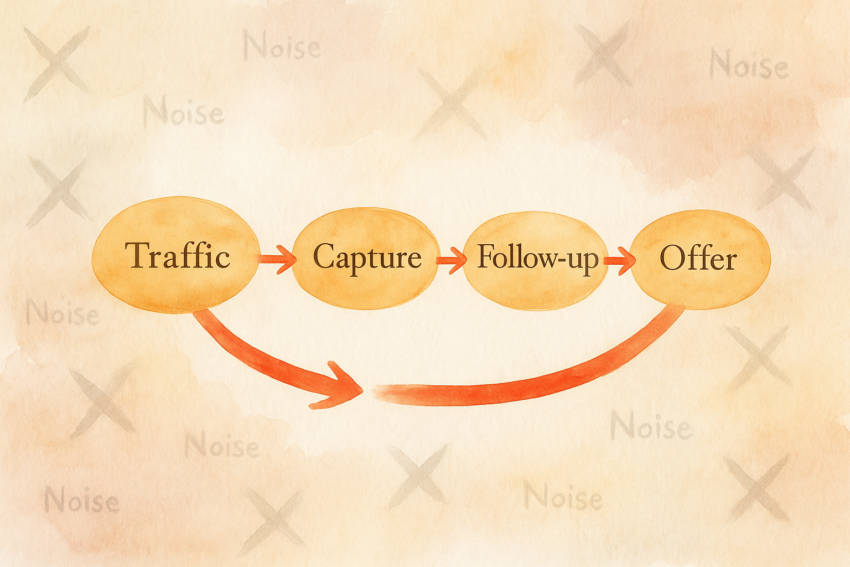
And that process can be broken down into four practical areas:
- Traffic
- Capture
- Follow-up
- Offer
Every successful beginner business whether it’s blog-based, TikTok-based, or email-based works because these four things are in place.
The rest? Optional. Nice to have. But not necessary to start.
Let me walk you through each one in plain language, the way I wish someone had explained it to me.
1. Traffic: You Don’t Need to Be Everywhere
Traffic simply means how people find you.
This is where most beginners panic, because it feels like you need to be on TikTok, Instagram, YouTube, a blog, Pinterest, LinkedIn all at once, posting three times a day, with perfectly edited content.
You don’t.
Traffic is not about doing everything. It’s about doing one thing consistently.
When I started, I made the mistake of trying to be everywhere. I’d post on TikTok one day, write a blog post the next, then feel guilty about not posting on Instagram. I was scattered, stressed, and making zero meaningful progress anywhere.
Everything changed when I picked one platform and committed to it for 90 days. Not because the platform was magic, but because I finally gave myself permission to go deep instead of wide.
As a beginner, your only goal with traffic is this:
Get in front of real people who are interested in learning.
That can happen through:
- Short videos
- Blog posts
- Helpful comments in communities
- Educational content
What matters is that you pick one platform you don’t hate using and stay there long enough to learn how it works, how the audience thinks, and how to create content that actually helps people.
A simple way to approach traffic as a beginner:
- Choose one platform. TikTok if you like video. A blog if you like writing. Pick based on your natural strengths, not what someone told you was “best.”
- Commit to showing up consistently. Not perfectly. Not with Hollywood production value. Just consistently.
- Share what you’re learning, not what you’ve “mastered.” The stuff confusing you right now? That’s content. The breakthrough you had yesterday? That’s content. Your journey is your content.
Here’s the truth: you don’t need viral content. You need repeatable content.
You need to be the person who shows up. Who’s helpful. Who feels real.
That’s how trust starts. That’s how traffic grows.
2. Capture: Don’t Let Interested People Disappear
This is the part most beginners skip and regret later.
I’ll be honest: I skipped this too at first. I thought if I just kept posting good content, people would come back. They’d remember me. They’d seek me out.
They didn’t.
Capture means having a simple way for people to stay connected to you.
Without capture, here’s what happens:
- Someone reads your post or watches your video
- They think, “Oh, that’s helpful”
- Then they scroll to the next thing
- And they forget you existed
Capture solves that.
It doesn’t have to be complicated. It can be as simple as:
- A free guide
- A short checklist
- A beginner eBook
- A “things I wish I knew” resource
The purpose is not to impress anyone. The purpose is not to create some massive lead magnet that takes you three weeks to build.
The purpose is to give value and stay in touch.
Think about it this way: if someone finds your content helpful once, there’s a good chance they’d find it helpful again. But social media algorithms are chaos. Posts get buried. Accounts get shadowbanned. People lose track.
Email is your safety net.
If someone gives you their email, they’re saying, “Yes, I want to hear from you again.” That’s powerful. That’s a real connection.
And here’s the beautiful part: your email list is yours. Not TikTok’s. Not Instagram’s. Yours.
Platforms can change their rules overnight. They can delete your account. They can make it impossible for your followers to see your content.
But they can’t take away your email list.
3. Follow-Up: Where Trust Actually Grows
This is the most misunderstood part of online business.
Follow-up is often mistaken for “selling” but in reality, it’s just continuing the conversation.
When someone joins your email list, they’re not saying, “Please sell me something immediately.” They’re saying, “I liked what you said. I’d like to hear more.”
Follow-up is where you deliver on that.
Follow-up is where:
- You explain things more clearly
- You share lessons you’re learning
- You help people avoid the mistakes you made
- You build familiarity and trust
As a beginner, your follow-up doesn’t need to be fancy or clever. It doesn’t need to follow some complicated seven-part psychological framework.
It can simply be you, being helpful.
Think about the emails you actually read and appreciate. They’re probably:
- Personal
- Clear
- Useful
- Not trying too hard to sell
That’s what good follow-up feels like.
Here’s how I approach it:
Every email I send, I ask myself: “Would I want to read this?”
If the answer is no, I rewrite it.
Your follow-up can be:
- Explaining something that confused you recently
- Sharing what you’re focusing on this week
- Breaking down a concept in plain English
- Telling a story that illustrates a lesson
If you can explain something to a friend over WhatsApp, you can do follow-up.
The key is consistency. Not perfection. Not brilliance. Just showing up in someone’s inbox regularly with something genuinely useful.
Over time, that builds trust. And trust is what turns strangers into customers.
4. Offer: You Don’t Need Your Own Product
This is another area where beginners overthink things.
An offer is simply something you recommend that genuinely helps the person you’re speaking to.
That’s it.
It doesn’t mean:
- Creating your own course
- Building software
- Writing a book
- Becoming an “expert” in something
Affiliate marketing exists so beginners don’t need to create products at the start.
You can recommend tools, courses, resources, or platforms that already exist, things you’ve actually used and believe in and earn a commission when someone buys through your link.
The key with offers is:
- Choose something beginner-friendly. Don’t recommend a $5,000 mastermind to someone who’s just starting out.
- Understand what it helps with. You should be able to explain, in one sentence, why someone might need it.
- Recommend it honestly, when it’s relevant. Not in every email. Not in every post. Just when it genuinely makes sense.
Here’s what I learned the hard way: you don’t need ten offers. You don’t need to sell all the time.
You just need one clear next step for someone who wants help.
If your content is about starting affiliate marketing, maybe you recommend a beginner course. If your content is about building landing pages, maybe you recommend GetResponse or Kit. If your content is about TikTok, maybe you recommend a video editing tool.
The offer should feel like a natural extension of the value you’re already providing.
When someone trusts you, and you’ve genuinely helped them, recommending something useful doesn’t feel pushy it feels like service.
What You Can Safely Ignore (For Now)
Here’s the thing: the internet will try to convince you that you need a thousand things to succeed.
You don’t.
If you’re at the beginning, you can completely ignore:
- Paid ads
- Complicated sales funnels
- Expensive automation software
- “Scaling” strategies
- Advanced branding and logo design
- Multiple niches
- Webinar funnels
- Retargeting campaigns
- SEO plugins and complicated analytics
None of these help if the four core areas aren’t in place.
In fact, they often slow people down.
I wasted so much time setting up fancy tools I didn’t need yet. I spent hours tweaking things that didn’t matter. I got distracted by advanced strategies when I hadn’t even mastered the basics.
Don’t make that mistake.
The beautiful thing about focusing on these four areas is that they work at any level. Whether you have 10 people on your email list or 10,000, the fundamentals are the same:
Get traffic → capture attention → follow up with value → make relevant offers.
Everything else is just optimisation. And you can’t optimise what doesn’t exist yet.
The Real Goal as a Beginner
Let me be straight with you: your goal right now is not to be impressive.
It’s not to be perfect. It’s not to “crack the algorithm.” It’s not to go viral or become an influencer or build a six-figure business in 90 days.
Your goal is to:
- Learn how the four areas connect. See how traffic feeds capture, how capture enables follow-up, how follow-up builds trust for offers.
- Build simple habits. Show up. Create content. Send emails. Recommend helpful things.
- Make small progress without overwhelm. One post. One email. One small win at a time.
That’s it.
If you can do that, if you can focus on traffic, capture, follow-up, and offers, and actively ignore everything else you’re already doing more than most beginners.
Most people never start because they’re waiting to understand everything. Or they start 50 things at once and burn out in two weeks.
You don’t have to be either of those people.
You can be the person who picks four things, gets decent at them, and builds something real.
One Last Thing
I know this post was different from the usual hype and promises you see online.
No “make $10K in 30 days.” No “secret hack the gurus don’t want you to know.”
Just the truth: this is simpler than it looks, but it requires focus.
If you focus on the four things that matter and ignore the noise, you give yourself a real shot at building something sustainable.
And honestly? That’s worth more than any quick win.
If this post helped you, share it with someone who needs to hear it.
Ready to skip the trial and error? Most beginners waste months on strategies that sound good but lead nowhere. I’ve made those mistakes and I created a free guide that calls out the 7 biggest lies keeping people from making real progress.
Get “7 Make Money Online Lies That Keep Beginners Stuck” and join my daily emails where I share what’s actually working, the lessons I’m learning, and the strategies behind my results. No theories, just real experience from someone building this business alongside you.
All the best,
Hi Atif – This is one of those posts that calmly pulls you aside and says, slow down, you are doing too much. The four focus areas make things feel manageable instead of overwhelming, which is exactly what most beginners need. I really like the reminder that progress came from doing fewer things consistently, not chasing every new tool or tactic. This strips away the noise and brings things back to basics in a way that feels honest and doable. Solid advice for anyone who feels busy but stuck. Thanks for this reminder and have a great and productive week!
Hi Ernie, appreciate you taking the time to read and share your thoughts. That line about feeling busy but stuck is spot on because I lived that for way too long, constantly moving but not actually getting anywhere meaningful. The hardest part for me was giving myself permission to ignore all the shiny objects and just focus on these four areas until they became second nature. Once I stopped trying to be everywhere and do everything, the actual progress started showing up. Thanks for the kind words, hope your week is productive as well.
Hi Atif, thanks for sharing, it was a great post! I really like your message and effort to simplify things into what’s really necessary and what’s not. So much noise out there that brings so much confusion to the process. You’re taking the time to weed out the unnecessary for those beginning online, which is very helpful! I like how you simply laid out, “people discover you → they begin to trust you → you recommend something helpful.” Look forward to your next post.
Hi Denny, thanks for reading and I’m glad the simplification landed with you. That’s exactly what I was going for because when I started, I felt paralysed by all the conflicting advice and steps that seemed essential but really weren’t. Breaking it down to that simple flow of discovery, trust, and recommendation helped me see that this isn’t actually complicated, it’s just been made to look that way. The noise is the real enemy for beginners, not the lack of information. Appreciate you being here and sharing your feedback.
Hi Atif,
Like so many things in life, we love to complicate our lives. It seems that its the same thing when we’re looking to start an online business.
We’re told we can make thousands in such a little amount of time that we forget that those spewing that information usually have a team working for them and possibly already have thousands of potential customers already willing to buy their products.
I love the fact that even though it seems so simple, that it actually is that simple.
Going back to a basic way of getting your business off the ground is really something that is easy. Follow what you’ve mentioned, give yourself time and avoid the distractions and it will succeed. Cheers!
Hi Marc, you hit on something really important there about the people selling those timelines conveniently leaving out the team, the existing audience, and all the infrastructure they already have in place. That gap between their reality and a beginner’s reality is massive, but nobody wants to talk about it because it doesn’t sell as well. What I’ve learned is that simple doesn’t mean easy, it just means clear. These four areas are straightforward to understand, but they still require showing up and doing the work consistently. The difference is you’re not wasting energy on distractions that don’t move the needle. Appreciate you reading and sharing your perspective.Thanks!
The secret here is not a secret at all-choose a platform, choose your audience, choose your time to implement the strategies presented here, and keep going, as you say. There will be momentum stoppers. It’s the small steps towards the goals we choose for ourselves that make the difference. Also important to keep in mind the overall vision, our “why.” Make every moment and day count.
Hi Kate, exactly right, the so-called secrets are usually just the fundamentals done consistently over time. What you said about momentum stoppers is real because they’re going to show up no matter what, but having that clear why keeps you anchored when things get messy or progress feels slow. I’ve found that when I’m clear on those four areas and my reason for doing this, the stoppers become bumps instead of roadblocks. Small steps compound in ways that aren’t obvious at first, but they do add up if you stick with it. Thanks for adding that perspective about making every moment count.
Awesome, Atif! I needed to read about getting Back To Basics because I lost sight of that and have been trying to do too much, which resulted in frustration, disappointment and guilt for not “doing everything” I should be doing. Or so the Internet experts say. There is so much noise out there, it is hard not to fall prey to some of it. What I like about you is you are practicing what you preach. You are successful and growing your business, and bringing people like me back to the basics just engenders even ore respect for you. Thank you for such a well written and informative post that I will be referring back to often.
Hi, really appreciate you sharing that because the frustration and guilt you described is something I know too well from my own experience. The internet experts are excellent at making you feel like you’re falling behind if you’re not doing seventeen things at once, but the truth is most of them are selling complexity to justify their courses or tools. What finally freed me up was realising I could build something real by just nailing these four areas instead of chasing every new tactic that popped up in my feed. I’m still learning and making mistakes, but sticking to the basics has been the only thing that’s actually moved my business forward. Thanks for the kind words and for being here, means a lot to hear this was helpful for you.
Hey Atif!
I love how you cut through all the noise and brought everything back to the basics without making it feel dumbed down. The way you explained traffic, capture, follow-up, and offers makes it feel doable instead of overwhelming.
Honestly, I really wish I had read something like this when I was starting out. It would’ve saved me so much time, stress, and second-guessing. What you said about beginners don’t fail because they aren’t capable, but because they’re trying to do everything at once, is something a lot of people need to hear.
This is the kind of post that helps people breathe, refocus, and take action. Great job!
Hi Meredith, thanks so much for that feedback, it means a lot coming from you. I tried hard not to oversimplify to the point where it loses meaning, but also not overcomplicate what’s actually pretty straightforward once you strip away all the extra layers. That line about capability versus overwhelm is something I had to learn the hard way because I spent months thinking I just wasn’t smart enough or didn’t have what it takes, when really I was just scattered across too many things. If this post saves even one person from that cycle of second-guessing and starting over, then it was worth writing. Appreciate you being here and sharing your thoughts.
Very helpful
Thank for reading, let me know if you have any questions, Atif